 By Natali Moss
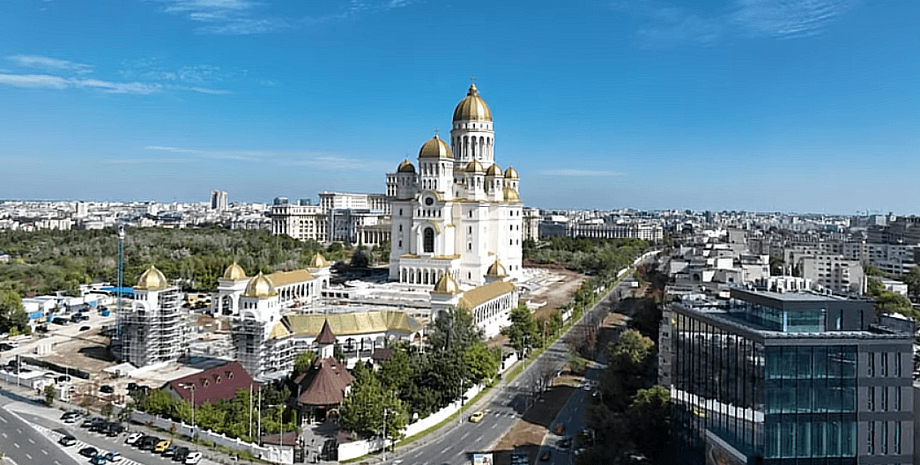
More than 300 million euros were spent on the construction of the cathedral. Most of the amount comes from taxes paid by Romanian citizens. It holds about 5,000 people, and more than 23,000 can gather in the square in front of it. The temple is distinguished not only by its height. Inside, too, everything is done monumentally. Yes, it boasts the world's largest iconostasis, the largest free-hanging bell and the largest collection of mosaics.
The latter are designed to create a sense of dynamism when the lighting changes during the day. In addition to the main premises, traditional for religious buildings, the cathedral has concert halls and even a shelter in case of a nuclear explosion. The church in Romania surpassed the Peter and Paul Cathedral in St. Petersburg, which was considered the tallest Orthodox building in the world for almost 300 years. Its height is 122. 5 meters, which is 4. 5 meters less than in Bucharest.
Analysts believe that this event has not only national significance, but is also a manifestation of the soft power that Romania has shown to Russia, which is strengthening its spiritual influence in the region. It is indicative that neither the Kremlin nor the Russian Orthodox Church has officially commented on the event, but the news has caused skepticism in Russia.
Pro-government Telegram channels questioned the Orthodox legitimacy of Romania, and also actively began to write about the crowd booing Prime Minister Ilie Bolojan and other officials at the opening of the cathedral. For his part, a researcher at the Romanian Center for Russian Studies at the University of Bucharest, Laurenciu Pleška, is sure that the cathedral in Bucharest has not only a religious, but also a geopolitical significance.
The Romanian Orthodox Church has about 19 million parishioners, and the Russian Orthodox Church has more than 90 million believers. After the start of the Russia-Ukraine war in 2022, the Russian Orthodox Church supported the Kremlin's military ideology and presented the war against Ukraine as a "fight against the forces of evil.
" Because of this, many priests and parishes outside of Russia, especially in Moldova, where the majority of the population speaks Romanian, have become disillusioned with the close connection of the Russian Church with the Kremlin. It is not surprising that the president of Moldova, Maia Sandu, sat in the first row at the opening of the cathedral in Bucharest. The new cathedral is already being called a symbolic gesture designed to offer an alternative to the Russian Orthodox Church.
"More and more countries do not agree with the policy of the Russian Church and its ties with the Kremlin. The new cathedral will be the largest and tallest Orthodox church in the world, and, in my opinion, it is a bright symbol of the cultural and spiritual influence of Romania in Eastern Europe," Pleška believes.
An expert on Eastern Christianity and international relations, Lucian Leushtean from the University of Aston, believes that the opening of the National Cathedral is connected not so much with a challenge to Moscow, but with the affirmation of the Romanian national identity. As a reminder, the final stage of the project to drain the walls and foundations of St. Sophia Cathedral and adjacent buildings has been completed in the "Sophia Kyivska" nature reserve.


 English
 Українська
 USA
USA Français
 Deutsch
 Italiano
 Polski
 Čeština
 Español
 Slovensku